
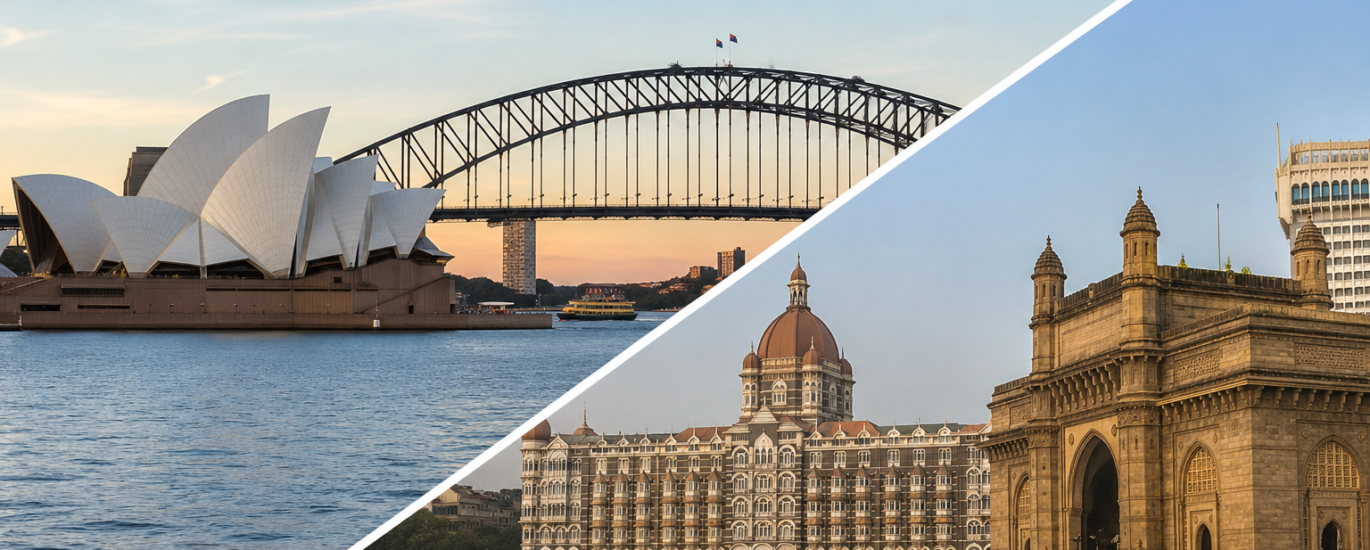
If you have recently moved from Mumbai to Sydney — or are planning to — chances are you have already converted almost every Australian expense into rupees at least once.
What This Guide Covers
ToggleA five-dollar coffee suddenly feels expensive. Weekly rent sounds confusing. Even something as simple as getting a haircut or taking an Uber can feel surprisingly costly in Sydney compared with Mumbai.
At first, many migrants wonder whether the higher Australian salary is actually enough to balance the much higher living costs.
The answer is not completely simple.
Sydney is undeniably more expensive than Mumbai in almost every category, including rent, groceries, transport, eating out, and services. However, salaries in Sydney are also significantly higher, and over time, many migrants feel that the overall quality of life, financial opportunities, and work-life balance improve substantially.
For most people, the real challenge is surviving and adjusting during the first one or two years.
The First Financial Shock Most Migrants Experience
One of the biggest surprises for Indians moving to Sydney is not just the prices themselves, but how differently money works in Australia.
In Mumbai, many people are used to monthly rent, affordable public transport, low-cost domestic help, and cheaper eating out. In Sydney, things operate very differently. Rent is usually paid weekly, most landlords require a bond deposit upfront, and services such as plumbing, cleaning, or repairs can cost hundreds of dollars.
Even grocery shopping feels different initially.
In Mumbai, local markets and small shops make daily life relatively affordable. You can still buy vegetables, snacks, or quick meals at very low prices. In Sydney, supermarkets are more organised and cleaner, but the overall grocery bill is much higher, especially for migrants who prefer Indian food products and spices.
Many migrants describe the first few months in Sydney as a constant mental calculation between Australian dollars and Indian rupees.
Over time that feeling slowly fades, but almost everyone experiences it in the beginning.
Quick Cost Comparison
Expense | Mumbai (approx.) | Sydney (approx.) |
3 bedroom house | ₹1.25 – ₹2.5 Lakh (per month) | $950 – $2000 (per week) |
Average professional salary | ₹17.25 lakh (per annum) | $96,000 – $105,000 (per annum) |
Monthly Public Transport | ₹500 – ₹1,125 (per person) | $200 – $215 (per month) |
Coffee | ₹80 – ₹200 | $5 – $6 |
Mid-Range Meal | ₹600 – ₹800 (for one) | $25 – $40 (for one) |
Monthly Groceries (family of 4) | ₹12,000 – ₹18,000 | $1,200 – $2,400 |
Petrol (per litre) | ₹111.18 – ₹111.21 | $1.87 – $2.32 |
(Conversion rate, 1 AUD = 67.98 INR)
Housing Costs — The Biggest Difference Between Mumbai and Sydney
Housing is usually the single largest expense for migrants moving to Sydney.
In Mumbai, rental prices vary enormously depending on location. Areas like South Mumbai, Bandra, and Juhu are extremely expensive, while Navi Mumbai, Thane, and outer suburbs provide more affordable options. Despite Mumbai’s high property prices, many families reduce costs through joint family living arrangements or smaller apartments.
Sydney’s rental market, however, feels expensive almost immediately for most new arrivals.
A one-bedroom apartment in a decent Sydney suburb can easily cost between AUD $2,200 and AUD $3,200 per month. What shocks migrants even more is the upfront cost involved in moving into a property. Most rentals require a four-week bond deposit along with advance rent payments before moving in.
This means a migrant family may spend thousands of dollars before even buying furniture.
Many new migrants initially choose shared accommodation or move further away from the Sydney CBD into areas like Parramatta, Blacktown, Liverpool, or Harris Park where rents are comparatively lower and Indian communities are larger.
Although Sydney housing feels dramatically more expensive, salaries are also much higher than Mumbai salaries. This is an important point many migrants only realise after settling.
Do Higher Sydney Salaries Actually Help?
One reason Sydney continues attracting migrants despite its high costs is the earning potential.
Professional salaries in Australia are significantly higher than equivalent roles in Mumbai. Skilled workers in industries such as IT, healthcare, engineering, construction, and finance often earn several times more than they would in India.
For example, a mid-level software engineer in Mumbai may earn between ₹12–20 lakh annually, while similar professionals in Sydney often earn between AUD $90,000–$130,000 per year.
Australia’s minimum wage is also among the highest in the world, which benefits students and temporary workers doing casual jobs.
However, higher income does not automatically mean an easier life initially.
The first year in Sydney can still feel financially stressful because migrants are setting up life from scratch. There are costs associated with housing, furniture, transport, mobile plans, and building local work experience. Many migrants also support family members overseas while trying to settle financially in Australia.
Still, over time, Sydney generally provides stronger long-term earning potential and financial stability for skilled migrants.
Grocery Shopping and Daily Expenses
Daily expenses are another area where migrants notice major differences between Mumbai and Sydney.
In Mumbai, eating out frequently is relatively affordable. Street food, cafés, local restaurants, and delivery services are available at prices most middle-class families can manage comfortably. Domestic help is also reasonably accessible for many households.
Sydney is very different.
While grocery quality is generally high and supermarkets are well organised, eating out regularly can become expensive very quickly. A simple café breakfast for two in Sydney can easily cost AUD $40–$50. Coffee culture is also a noticeable lifestyle change for many migrants, with Australians commonly spending AUD $5 or more on a single coffee.
Indian grocery stores in suburbs such as Harris Park and Parramatta help migrants manage costs by offering familiar products like rice, spices, frozen rotis, snacks, and lentils. Aldi is also popular among migrants trying to reduce supermarket spending.
Still, groceries overall remain significantly more expensive than Mumbai, especially products such as dairy, meat, and imported Indian items.
The good news is that most migrants slowly learn how to manage these expenses better after a few months of adjusting to Australian life.
Transport Costs and Car Expenses
Mumbai’s public transport system is crowded but highly affordable. Local trains, buses, autos, and metro systems allow millions of people to commute daily at relatively low cost.
Sydney’s public transport system is cleaner, more reliable, and easier to navigate, but commuting costs are much higher.
Regular train travel using an Opal card can become expensive over time, especially for people travelling long distances from outer suburbs into the city for work. In addition, many areas of Sydney are car-dependent, particularly for families.
This introduces another financial adjustment for migrants.
Owning a car in Sydney involves registration costs, insurance, fuel, servicing, parking, and toll roads. Toll charges alone can surprise many migrants who are not used to paying daily road fees in India.
As a result, many migrants try to live near train stations during their first few years to reduce transport expenses.
The Lifestyle Difference Beyond Just Money
Although Sydney is more expensive, many migrants eventually feel the lifestyle advantages begin balancing the higher costs.
Compared with Mumbai, Sydney generally offers cleaner public spaces, better air quality, less overcrowding, safer roads, and stronger work-life balance. Employees often receive better leave entitlements and workplace protections compared with what many professionals experience in India.
For families, access to parks, beaches, healthcare, and public infrastructure also becomes a major advantage over time.
However, there is another side that migrants rarely talk about enough.
Moving from Mumbai to Sydney can feel emotionally difficult during the beginning. Many Indians miss the convenience, energy, and social closeness of Mumbai. Family support systems, festivals, affordable food, and the “always busy” atmosphere are difficult to replace.
Sydney offers more independence and personal space, but it can also feel isolating initially.
Most migrants slowly adapt by building social circles and connecting with Indian communities across Sydney suburbs.
So, Can You Actually Save More in Sydney?
This ultimately depends on your profession, visa status, and family situation.
Students and temporary workers often find the first few years financially challenging due to high rent and limited work hours. Families with children may also struggle with Sydney’s expensive childcare costs.
However, skilled migrants in stable professional jobs often find that long-term savings potential improves significantly after settling. Higher salaries, stronger currency value, retirement savings through superannuation, and better career growth opportunities can create much stronger financial stability over time compared with Mumbai.
The key difference is that Sydney usually rewards long-term settlement rather than immediate comfort.
Final Thoughts
Sydney is unquestionably more expensive than Mumbai.
There is no hiding that reality.
But for many migrants, the comparison eventually becomes about more than just converting dollars into rupees. Over time, people begin comparing lifestyle, safety, work culture, financial growth, healthcare, and future opportunities as well.
The first year in Sydney is usually the hardest. Almost every migrant experiences financial pressure, adjustment stress, and moments of questioning whether the move was worth it.
But many also remember the moment life slowly became more stable — the first proper job, the first savings account growing steadily, or the first apartment that finally started feeling like home.
For many Indian migrants, Sydney may initially feel expensive, but over time, it often becomes the place where long-term financial and personal stability truly begins.
References
Budget Direct Australia (2026). Sydney vs Mumbai cost of living comparison. Available at: https://www.budgetdirect.com.au/interactives/costofliving/compare/sydney-vs-mumbai/
Versus (2026). Mumbai vs Sydney comparison. Available at: https://versus.com/en/mumbai-vs-sydney
Numbeo (2026). Cost of living comparison between Mumbai and Sydney. Available at: https://www.numbeo.com/cost-of-living/compare_cities.jsp?country1=India&city1=Mumbai&country2=Australia&city2=Sydney
TechCities (2026). Sydney compared to Mumbai. Available at: https://techcities.app/city/sydney/compared-to/mumbai
Author

OzMoneyTalks Editorial is the research and content team behind OzMoneyTalks. Built by Indian migrants, now Australians, with over 20 years of experience across finance, insurance, and services on both sides of the India-Australia corridor. Every article draws from real migrant stories, lived decisions, and independent research reviewed for accuracy before publication